Caring for elderly parents, starting with what you can share
Last reviewed: 21 October 2026 · The Peaflow team
Caring for an elderly parent usually starts with a clear list of tasks and a shared record, not with an app deciding care. NIA says families should sort out what is needed and who will do which part. Peaflow, if you use it, only reminds and records medications on a schedule you confirm. It does not give medical advice.
This page is a starting point for adult children and spouses who are beginning to help an older parent. It covers what the big caregiving surveys count, how families can share the work, and where medications fit in. It also links to our pages on the medication side of care. It is not a legal, financial or housing guide.
Who this hub is for
If you are helping a parent, you are far from alone. The Bureau of Labor Statistics reports that in 2023 to 2024, 14% of the civilian noninstitutional population age 15 and over, or 38.2 million people, provided unpaid eldercare. Here, eldercare means unpaid care for someone age 65 or older who needs help because of a condition related to aging. Almost half of those providers (47%) cared for a parent.
The Caregiving in the U.S. 2025 report from the National Alliance for Caregiving and AARP found that 63 million American adults provided ongoing care to adults or children with a medical condition or disability. In the full report, 40% of caregivers of adults were caring for a parent, and 7% for a parent-in-law.
The two surveys define caregiving differently, so their totals can't be added together.
Start with the tasks, not a product
The National Institute on Aging's advice on sharing caregiving responsibilities begins with the work itself: figure out what is needed, choose a primary caregiver, and decide who does which task. NIA also suggests having that conversation calmly, rather than in the middle of a crisis.
Then comes keeping everyone informed. NIA suggests a notebook, paper or electronic, kept somewhere everyone can open it, and notes that some smartphone apps can divide duties, keep a calendar and share updates. More on all of this is in NIA's caregiving pages.
Peaflow is not that whole notebook. It covers one piece of it: the medication reminder and the record of which doses were confirmed. Appointments, money, housing and the rest still need their own place.
The medication piece
The National Institute on Aging says: "As you age, you may be taking more medications." According to the National Center for Health Statistics, 88.6% of U.S. adults age 65 and older took prescription medication in the past 12 months in 2021 to 2022, among the civilian noninstitutionalized population. That is a measure of how many people use prescription medicine. It is not a rate of missed doses.
The times for each medicine come from the pharmacist or doctor, not from an app and not from this page. If a label uses shorthand such as BID or PRN, prescription abbreviations explains what the letters mean. Ask the pharmacist which times to use.
How families use Peaflow
From the App Store listing: scan the pharmacy label on the iPhone, check every field, and confirm the times. Your parent taps "Taken" when they take a dose, and you see who confirmed it and when. With Plus, you can add more people to the care circle, receive missed-dose alerts, set quiet hours so nobody is woken for a late evening dose, and see 30 days of history and adherence, along with patterns and questions to bring to the doctor.
The Free plan covers two medications, reminders and the one-page doctor PDF, with a care circle of the owner and the parent. Plus is $29.99 a year after a 3-day free trial, or $79.99 once. Both plans are compared below, as on Peaflow pricing, checked on 21 October 2026.
| Feature | Free ($0) | Plus ($29.99/year) |
|---|---|---|
| Profiles (you or family) | 1 | Unlimited |
| Medications | 2 | Unlimited |
| Reminders on caregiver and dependent phones | Yes | Yes |
| Dose log and 7-day adherence | Yes | Yes |
| Doctor PDF | Yes | Yes |
| Care circle members | Owner + parent | Unlimited |
| Missed-dose alerts to the circle | No | Yes |
| 30-day adherence and per-medication history | No | Yes |
| Refill reminders | No | Yes |
| Health log (readings and symptoms) | No | Yes |
| Widgets and Live Activity | Yes | Yes |
The dose log and 7-day adherence row comes from the pricing page; it isn't in the App Store listing.
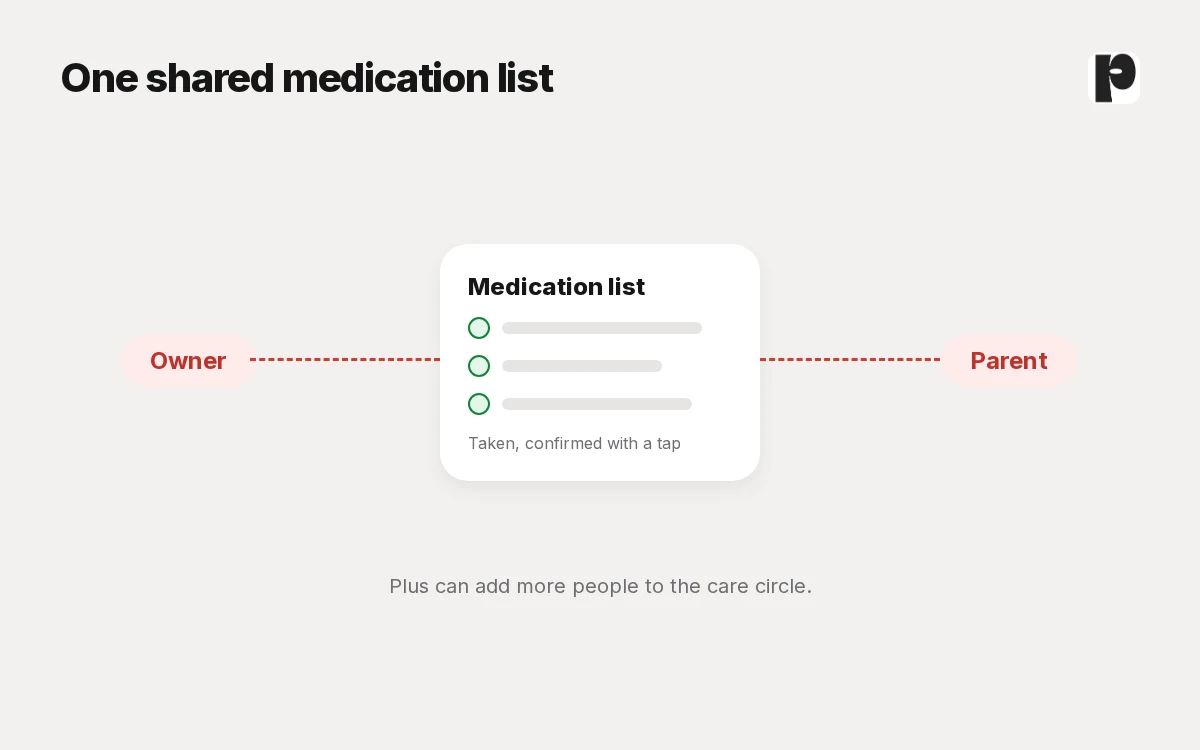
Peaflow reminds and records on the schedule you confirm. It does not give medical advice, and it is not a full caregiving platform: it doesn't handle finances, housing, hiring help or location. For more on the reminders, see the pill reminder app page. For the dose log and the doctor PDF, see the medication tracker app page.
Pages in this section
- medication reminders for elderly parentsHow reminders, the "Taken" tap and missed-dose alerts work when you look after a parent, including from far away.
- caregiver app for familiesPlus lets you invite a sibling or helper to one medication list and one history, and Peaflow doesn't track location.
If you live far away
The National Institute on Aging says that if you live an hour or more away from a person who needs care, you are a long-distance caregiver. From a distance you can still keep records and coordinate with the person who is close by. Peaflow does not replace that person. It can show you which doses were confirmed, so the daily call can be about something else.
Questions about setting things up? Peaflow support can help. Or start at Peaflow.
Questions people ask
Where do I start when I am caring for an elderly parent?
NIA's advice is to list what care is needed and who will do each part, in a conversation that is not saved for a crisis. A current medication list, with times from the pharmacist, is one part of that. Peaflow can remind and record. It cannot decide the care.
How common is caring for a parent?
In the BLS eldercare release for 2023 to 2024, 47% of unpaid eldercare providers cared for a parent. In Caregiving in the U.S. 2025, 40% of caregivers of adults were caring for a parent. The surveys define caregiving differently, so the two figures shouldn't be averaged or combined.
Can siblings share a medication list?
On Peaflow, the Free care circle is the owner and the parent. Plus adds more people, and invited people see the same list and the same history. Missed-dose alerts are Plus.
Does Peaflow give medical advice?
No. "peaflow is a reminder and record-keeping tool. It doesn't give medical advice. Always confirm changes with a pharmacist or doctor."
What if I do not live nearby?
NIA calls you a long-distance caregiver if you live an hour or more away. You can still keep records and coordinate with the person who is close by. Peaflow does not replace that person.