Prescription abbreviations, in plain English
Last reviewed: 17 October 2026
The label says "1 tab PO BID." The pharmacist said something about mornings. You're standing in the kitchen trying to remember which.
Prescription shorthand is old, Latin-based and easy to misread. This page gives the meanings from the National Library of Medicine's MedlinePlus, explains which abbreviations safety groups say not to use at all, and is clear about the one thing a dictionary can't tell you: what time to take anything.
The four you'll see most: BID, TID, QID and PRN
These are the meanings listed in MedlinePlus Appendix B, Some Common Abbreviations:
| Abbreviation | Meaning (MedlinePlus) |
|---|---|
| BID | Twice a day |
| TID | Three times a day |
| QID | Four times a day |
| PRN | As needed |
Where do the letters come from? MedlinePlus explains that b-i-d comes from the Latin "bis in die", which means twice-daily dosage. That's why the letters don't match the English words on your bottle.
You may see them in capitals, lower case or with full stops (bid, b.i.d.). On a label or prescription, they mean the same thing.
BID: twice a day
BID is the shorthand behind "twice a day" on a pharmacy label. It is also what people mean when they search for the medication twice a day abbreviation. It tells you how many times. It doesn't say which two times.
TID: three times a day
TID means three times a day. Same rule: it counts doses across the day and leaves the timing to the person who wrote it and the pharmacist who filled it.
QID: four times a day
QID means four times a day. With four doses, the gaps between them get small, which is exactly why the actual times belong in a conversation with your pharmacist.
"Three times a day" is a count, not a clock time
It's tempting to do the maths. Twenty-four hours, three doses, so TID must mean a fixed gap. Don't. MedlinePlus defines TID as three times a day and stops there. It doesn't give hours, and neither will we.
Some medicines are meant to be spaced evenly. Others are timed to meals, to sleep, or to other medicines on the list. The abbreviation alone can't tell you which kind you have. The right schedule depends on the drug and on you, and that's a question for the people who know both.
So ask. Next time you pick up a prescription, ask the pharmacist: "What times should these be taken, and does it matter if they're with food?" Write the answer down. That answer is your schedule, and it can turn into reminders.
QD and QOD: write "daily" and "every other day" instead
You may still find QD on an old prescription or in a search result. It shouldn't be treated as a normal abbreviation.
QD (daily) and QOD (every other day) are on the Joint Commission's official "Do Not Use" list. They also appear on the ISMP List of Error-Prone Abbreviations. The fix both lists point to is the same: spell it out. "Daily." "Every other day."
If you see QD or QOD on something you've been given, don't guess. Ask the pharmacist to confirm what was meant, and ask for it written in words.
PRN: "as needed," with limits only your label can set
PRN means as needed. It's the one abbreviation that doesn't describe a schedule at all.
"As needed" still has rules. How much, how often and for what reason come from your label and your prescriber only, not from the abbreviation and not from a website. If the label doesn't say, or you're unsure, ask the pharmacist before you take it.
Turning your pharmacist's schedule into reminders
Once you have real times from your pharmacist, the hard part is remembering them, especially if you're looking after a parent's medicines from another town.
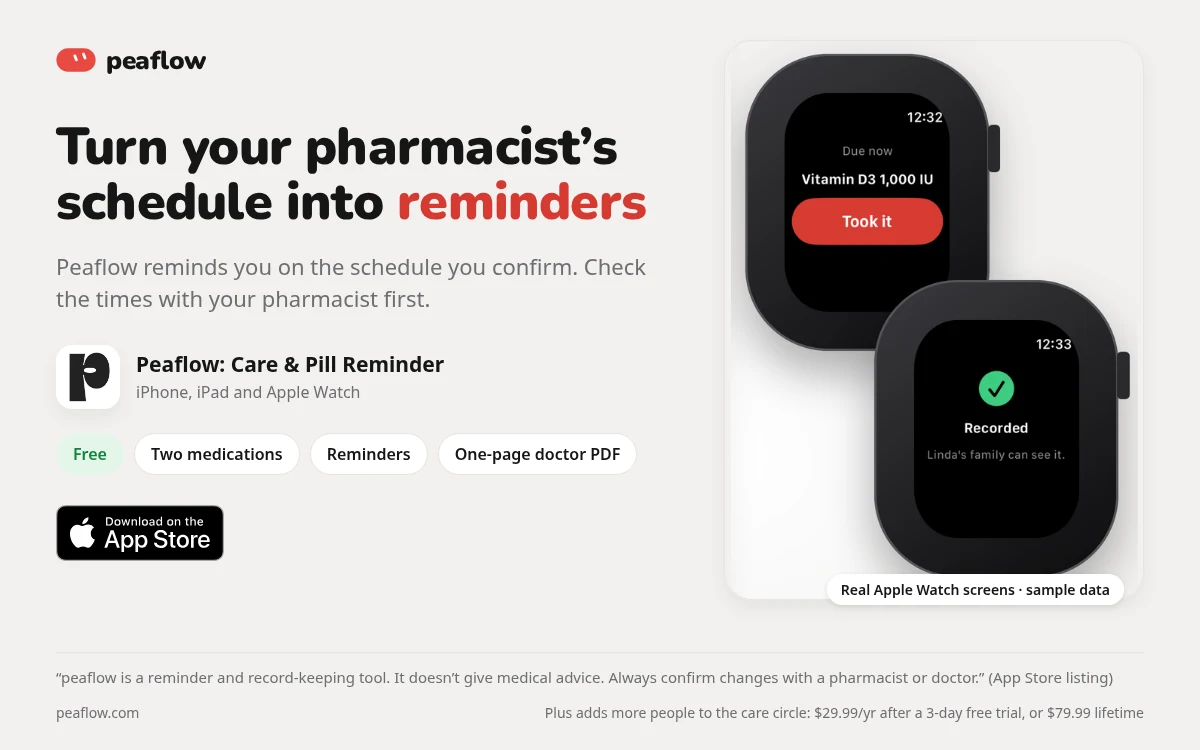
That's what Peaflow: Care & Pill Reminder is for. It's a pill reminder app for iPhone, iPad and Apple Watch. You scan the pharmacy label, check every field, and confirm the schedule. It reminds on the schedule you confirm. It doesn't decide what that schedule should be.
- Free: two medications, reminders and the one-page doctor PDF, plus a one-tap "Taken".
- Plus: $29.99 a year after a 3-day free trial, or $79.99 once for lifetime. It adds more people to the care circle, missed-dose alerts for the whole circle, 30 days of history and adherence, patterns and questions to bring to the doctor.
You can see plans and pricing in detail, or find help on the support page.
Questions about prescription abbreviations
What does BID mean?
BID means twice a day, according to MedlinePlus. It comes from the Latin "bis in die." It tells you how many doses, not which times. Ask your pharmacist when to take them.
What does TID mean?
TID means three times a day, according to MedlinePlus. Your pharmacist can tell you the times that suit your medicine.
Does TID mean every 8 hours?
Not necessarily. MedlinePlus defines TID only as three times a day. Some medicines are timed to meals or other medicines, so ask your pharmacist what times to use.
What does PRN mean?
PRN means as needed. Any limits on how much or how often come from your label and your prescriber only.
Why shouldn't QD be used?
QD (daily) is on the Joint Commission "Do Not Use" list and the ISMP List of Error-Prone Abbreviations. Write "daily" instead. For QOD, write "every other day."
Can Peaflow tell me when to take my medicine?
No. Peaflow reminds you on the schedule you confirm. It doesn't give medical advice. Confirm timing and any changes with your pharmacist or doctor.
Next step: take your bottles to the pharmacy counter, ask for the times in plain words, then put those times into reminders.